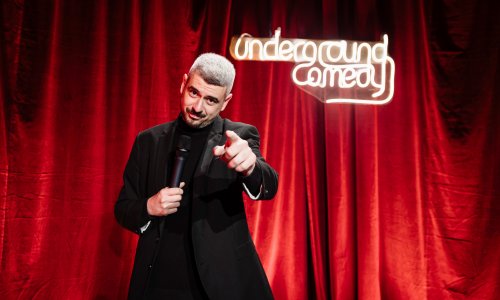
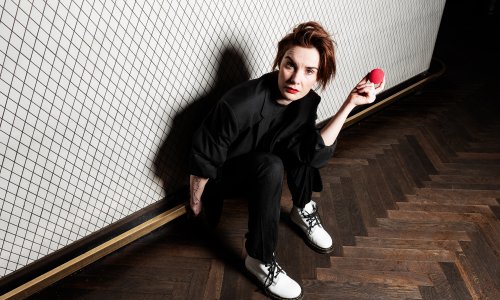
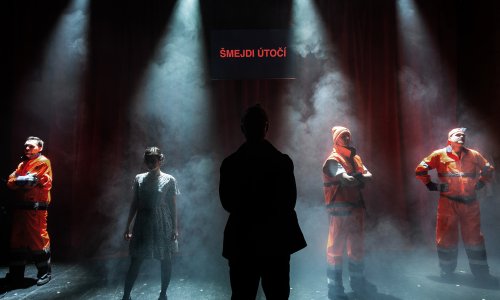
Scamming is art. They have been with us since the beginning of mankind. They are all around us. And they are more and more of them. There´s no place you…
This performance is in Czech only!
This performance is in Czech only.
This performace is in Czech only.
This performance is in Czech only!
This performance is in Czech only.
A new original production by the creative collective 8lidí. Pleasant heat. Thick steam. The scent of citrus. Western society relaxes in sauna worlds,…

This performance is in Czech only!
This performace is in Czech only.
Scamming is art. They have been with us since the beginning of mankind. They are all around us. And they are more and more of them. There´s no place you…
This performance is in Czech only!
This performance is in Czech only.
Galerie NoD
Radek Brousil & Viktor Timofeev
The Hammer Strikes the Bell
Kurátoři / Curated by: Boris Ondreička & Pavel Kubesa
16. 4. – 10. 5. 2026
Opening: 15. 4. 2026, 18:00
---
To draw away: 2 subjects in 1 superject
Both bodies of work by Radek Brousil and Viktor Timofeev might manifest as abstract constellations. If, however, this is not abstraction resulting from an eruption of emotional inner urge, but rather a calm analytical process based on the observation of spatiotemporal dimensionality (orientation, organisation, navigation). This text is non-descriptive. It aims to explain methodological mechanisms I have identified behind both groups of works and propose a particular point of departure or perspective for “reading” their narratives, which are embedded more deeply in the works of both artists.
/ / /
Abstraction comes from Latin abs- (“away”) + -trahō (“to draw” / from material object).[1] To draw away[2] means logical separation and transfer. Transfer is a process of space and time.[3] In abstraction, it is also a transfer from objective to subjective. To draw away requires a selection. It is an eclectic operation. The selection is influenced by various irritants that trigger individual responses. 2 in 1 means syncresis then. 2 in 1 creates superject.[4]
Even if we would expose Abstract Art (non-formal, non-figurative, non-objective / object-free, non-representational)[5] as purely inner coming from within per se, we must not forget, how some Abstract gradually arrives through the investigation of outer natural (landscape...) substrate, its deconstruction heading towards an insight into the fundamental (core) nature of (infra-)structures and systems. This often involves delving into the irrational and the subconscious. So, we must also follow a certain evolution of the transformation (stylisation) of Real / Concrete into Abstract. Abstract (sometimes just partial or even apparently abstract) obviously hides a Figurative image.[6] Abstract is not any antonym of Realistic necessarily.[7]
To generalize and simplify: the “surface” of Abstract Art is globally accessible because it does not use structures of any formal language so that’s why is not isolated in its own local (cultural…) context. Abstraction moves beyond the particulars of the word / of the world (the messy, changing, individual things) to reach universals (the stable, underlying truths). Lingua abstracta creates specific systems of logic, ethics, and metaphysics that apply to existence as a whole, rather than just one specific instance. If concrete thought looks at what is here, abstract thought looks at what makes it what it is. Lingua abstracta is a semantic (hermeneutical and heuristic) system open for emancipated interpretation.
If we analyse the relationship between the subjective and the objective in abstract terms, we must also mention traffic signs, which are mostly pure geometric shapes of specific colours, and these have established themselves as objective (albeit somewhat open to interpretation on limited scale) fixed meanings. The signal when the hammer strikes the bell[8] is part of orientation, navigation context too. The Hammer Strikes the Bell oscillates between the subjective and the objective, between a non-dimensional subject and a four-dimensional object.
When it comes to time, both artists[9] also draw on various historical perspectives. Brousil eclectically refers to Max Ernst (1891¾1976) and his invention of frottage (which certainly has a relation to objet trouvé, street culture and its politics), a technique whose story continues into Tachism[10], while Timofeev refers to the experimental multimedia NSRD (Nebijušu Sajūtu Restaurēšanas Darbnīca¾Latvian for “Workshop for the Restoration of Unfelt Feelings,” 1982¾1989)[11]. So, in The Hammer Strikes the Bell, Modern and Contemporary ring together to achieve atemporality[12] through abstraction.
Boris Ondreička, 2026
---
[1] The intellectual concept of abstraction in philosophy is rooted in the work of Aristotle (4th century BCE / Meta-physics K and M), who described the mental process of grasping (isolating) universals through sense (physical, realistic) experience: aphairesis (ἀφαίρεσις¾“subtraction, separation, detachment, cutting off”) or ta ex aphaireseôs (τὰ ἐξ ἀφαιρέσεως¾“things that exist from abstraction / removing)”.
[2] The word drawing (pictures, this usage appeared around 1200) is based on dragging a stylus or pencil across a surface. Drawing (painting…) is both a present participle (verb, object, commodity) as well as a gerund (noun, process, action).
[3] The emergence of art through pure transfer from one (place) to another was described as early as by John Dewey in his Art as Experience (Minton, Balch & Co., 1932), pioneering the shift from object-oriented to process-oriented thinking about art.
[4] As Alfred North Whitehead described in Process and Reality (The Free Press, 1929), the SUBJECT (“under”), undergoing creative and empirical concretization, achieves fulfilment (only) in the reality it has absorbed along the way (from intimate to extimate)¾including through knowledge of the mechanisms of its own motivations. It becomes a SUPERJECT (“above”).
[5] Abstract Art is a question of (conceptual) intention, (automatic or controlled) process and/or (post-produced) result. Some artists create Abstract paintings consciously and deliberately, while others would even refuse to be classified as part of Abstract Art, claiming that they are simply spontaneously creating art (or even just “something”) as such. Sometimes the framework of an abstract “sounding” work is just a sedimental trace of past physical (corporeal tailing…) action (ephemera, memorabilia, documentation) or even just an accident or found ready-made later appropriated (transferred, re/placed, commodified).
[6] The development of Abstract from Figurative is perfectly described by Rose-Carol Washton Long in her Kandinsky and Abstraction: The Role of the Hidden Image, Artforum, NYC, Summer 1972, pp 42¾49.
[7] In their Realistic Manifesto (a key text of Constructivism, 1920), Naum Gabo and his brother Antoine Pevsner understood Geometric Abstraction as a form of Realism. Realism here does not necessarily mean how things “are” (mimetically, classically, retrospectively), but (also) how they “could, can” or “should be” (innovatively, creatively, avant-garde, prospectively). So, Realism and imagination (Surrealism) are not contradictory. So, Realism does not mean being a slave to reality but rather being its master. So, Realism is not necessarily Figurative. So, Realism can be constructive.
[8] In an electric bell, the hammer strikes the gong due to magnetic force generated by an electromagnet when the circuit is closed, and it produces a sound by inducing vibrations in the metal. The current activates the magnet, attracting the iron armature/hammer to strike the gong, which often breaks the circuit momentarily to allow the hammer to spring back. The Hammer Strikes the Bell is the 9th 04:51min track of Goodness album by feeo released on October 10, 2025, exploring the tension between connection, isolation, and opposing states of being, such as light and darkness, the curiosity of humanity¾why things “ring”¾and touches on accepting the dual nature of people who can both love and hurt, ultimately acting as a poignant meditation on human existence.
[9] Both artists live and work in different time zones. When Radek being back to Prague speaks to Viktor (who lives in NYC) at noon it is 6AM for the other.
[10] Radek mentions also 1960s Czech artists Dalibor Chatrný, Vladimír Boudník, Mikuláš Medek, Alena Kučerová or Olga Karlíková. The fact that he feels an affiliation to the work of artists from that era also leads him to reflect on the political dimension of their art and his own. He compares the individual artistic stances of these artists with their era and his own (Zeitgeist).
[11] Viktor refers to Ilya Kabakov’s Total Installations too, and one can feel also influence of utopian visions of prospective architects such as Michael Webb, Paolo Soleri, Douglas Darden, Raimund Abraham, Paul Nelson, Oscar Nitzchke, Frantz Jourdain, Arata Isozaki, Lebbeus Woods, Paul Rudolph, Archigram, Superstudio or Neil Spiller.
[12] In his 2010 Transmediale X (February 6, 2010) keynote Atemporality for the Creative Artist, cypherpunk Bruce Sterling defines atemporality as a post-postmodern, networked state where history collapses, making all times feel equal. It is a “calm, pragmatic, and serene skepticism” towards traditional linear narratives, driven by digital technology. Sterling argued that the 21st century is not progressing linearly but is stuck in a loop where historical periods are sampled and remixed endlessly. In Wired, February 25, 2010, 5:47 PM.