Program
About NoD
#divadlo #galerie #cafébar #vernisáž #přednášky #ostatní

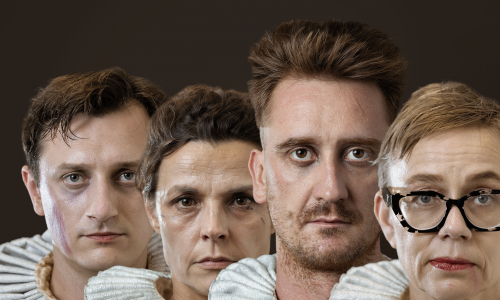
JÁ, DIAGNÓZA / + - VeDvou

Radek Brousil & Viktor Timofeev: The Hammer Strikes the Bell

How can one depict the city today when it is no longer merely an urban whole, but also a psychic landscape, a data infrastructure, and a space of permanent tension? And how can one grasp the metropolis at the moment when its everyday reality breaks down into layers of personal projections, collective affects, and invisible systems that shape our movements, relationships, and modes of perception? The international exhibition project The Hammer Strikes the Bell by New York-based Latvian artist Viktor Timofeev and Czech artist Radek Brousil, prepared together with curators Boris Ondreička and Pavel Kubesa for Prague’s NoD Gallery, enters precisely this field of meaning. Here, the city does not appear as a stable backdrop, but as a living, multilayered organism in which subjective experience collides with the logic of late-postmodern infrastructures. The joint project by Brousil and Timofeev is conceived as a complex exhibition situation in which images, drawings, and a spatial site-specific installation are interwoven into a scenographic whole. The exhibition reflects the specific chronotope of the metamodern gigapolis — a city that is simultaneously a concrete place and a mental state, a set of material structures and a field of imagination. The artists are interested in the intricate image of buildings, people, technologies, and collective psyche that emerges from the structures of today’s metropolises. The exhibition is therefore not built on a mere dialogue between two media or two artistic signatures. More important is the very nature of their encounter: both Brousil and Timofeev have long cultivated a sensitivity to what remains beneath the surface of the visible world, whether power regimes, infrastructures, cultural codes, or unspoken models of identity. From this perspective, The Hammer Strikes the Bell transforms the gallery space into a situation in which the city becomes not only a theme, but also a method. The viewer does not enter a closed narrative, but rather a mutable scenery in which a wide range of individual and collective dramas may unfold. Viktor Timofeev (*1984), whose practice clearly extends beyond the framework of Central and Eastern Europe, is an internationally established artist living and working in New York, whose interdisciplinary practice brings together drawing, painting, video, sound, software, and experimental games into complex environments situated at the intersection of autofiction, worldbuilding, and systems thinking. In 2025, he presented his most extensive museum exhibition to date, Other Passengers, at the Latvian National Museum of Art in Riga; he has also exhibited at the Hessel Museum of Art in New York, Bozar in Brussels, and the National Gallery in Prague. Radek Brousil (*1980) enters this dialogue as an artist who has long reflected on the relationship between image, material, and social reality. In his post-photographic approach, he combines photography with textile, object, video, installation, and painting, and consistently engages with socio-political and environmental themes, postcolonial tendencies, and the question of a “new sensibility.” His work grows out of a critical relationship to standardized interpretations of late capitalism, the Anthropocene, and global power relations, and has increasingly also turned toward the politics of time. Brousil is among the notable figures of the Czech art scene with strong international experience, as confirmed by his projects in London, Brussels, Budapest, Tokyo, and other institutions.  

Vyprodáno

MICHAELŮV MASHUP

This event is in Czech only!

Vyprodáno

27 LITRŮ UMĚLÝ KRVE / Janek & Natálka & kol.

Vyprodáno

27 LITRŮ UMĚLÝ KRVE / Janek & Natálka & kol.

Vyprodáno

27 LITRŮ UMĚLÝ KRVE / Janek & Natálka & kol.

MICHAELŮV MASHUP

This event is in Czech only!

FAKE CRIME / Joke Division

This performance is in Czech only!
Premiéra

MICHAELŮV MASHUP

This event is in Czech only!

UNDERGROUND COMEDY CLUB

This performance is in Czech only.

HAMU Graduate Choreography Showcase

An evening of graduation projects by third-year choreography students at the Academy of Performing Arts (HAMU).  Nadkroví Barbora Sváčkov…

ŠPIONI / Brémy

This performance is in Czech only!

JÁ, DIAGNÓZA / + - VeDvou

JAK SE DĚLÁ DIVADLO / Divadlo MASO

This performace is in Czech only.

Vyprodáno

27 LITRŮ UMĚLÝ KRVE / Janek & Natálka & kol.

Vyprodáno

27 LITRŮ UMĚLÝ KRVE / Janek & Natálka & kol.

Vyprodáno

27 LITRŮ UMĚLÝ KRVE / Janek & Natálka & kol.

Vyprodáno

THE LEGEND OF LUNETIC / Janek & Natálka & kol.

This performance is in Czech only!

Vyprodáno

THE LEGEND OF LUNETIC / Janek & Natálka & kol.

This performance is in Czech only!

Vyprodáno

THE LEGEND OF LUNETIC / Janek & Natálka & kol.

This performance is in Czech only!

SCAMMERS ATTACK / Janek & Natálka & collective

Scamming is art. They have been with us since the beginning of mankind. They are all around us. And they are more and more of them. There´s no place you…

SCAMMERS ATTACK / Janek & Natálka & collective

Scamming is art. They have been with us since the beginning of mankind. They are all around us. And they are more and more of them. There´s no place you…

FAKE CRIME / Joke Division

This performance is in Czech only!

THE LEGEND OF LUNETIC / Janek & Natálka & kol.

This performance is in Czech only!

THE LEGEND OF LUNETIC / Janek & Natálka & kol.

This performance is in Czech only!

THE LEGEND OF LUNETIC / Janek & Natálka & kol.

This performance is in Czech only!

27 LITRŮ UMĚLÝ KRVE / Janek & Natálka & kol.

27 LITRŮ UMĚLÝ KRVE / Janek & Natálka & kol.

27 LITRŮ UMĚLÝ KRVE / Janek & Natálka & kol.

UNDERGROUND COMEDY CLUB

This performance is in Czech only.

JAK SE DĚLÁ DIVADLO / Divadlo MASO

This performace is in Czech only.

THE LEGEND OF LUNETIC / Janek & Natálka & kol.

This performance is in Czech only!

THE LEGEND OF LUNETIC / Janek & Natálka & kol.

This performance is in Czech only!

THE LEGEND OF LUNETIC / Janek & Natálka & kol.

This performance is in Czech only!

FAKE CRIME / Joke Division

This performance is in Czech only!

UNDERGROUND COMEDY CLUB

This performance is in Czech only.
27 LITRŮ UMĚLÝ KRVE / Janek & Natálka & kol.

27 LITRŮ UMĚLÝ KRVE / Janek & Natálka & kol.

27 LITRŮ UMĚLÝ KRVE / Janek & Natálka & kol.

THE LEGEND OF LUNETIC / Janek & Natálka & kol.

This performance is in Czech only!

THE LEGEND OF LUNETIC / Janek & Natálka & kol.

This performance is in Czech only!

JAK SE DĚLÁ DIVADLO / Divadlo MASO

This performace is in Czech only.

SCAMMERS ATTACK / Janek & Natálka & collective

Scamming is art. They have been with us since the beginning of mankind. They are all around us. And they are more and more of them. There´s no place you…

SCAMMERS ATTACK / Janek & Natálka & collective

Scamming is art. They have been with us since the beginning of mankind. They are all around us. And they are more and more of them. There´s no place you…

JÁ, DIAGNÓZA / + - VeDvou

FAKE CRIME / Joke Division

This performance is in Czech only!

UNDERGROUND COMEDY CLUB

This performance is in Czech only.
Sign up for the newsletter

cz

PETER WATKINS: Mother Tongue

Galerie NoD
Peter Watkins
Mother Tongue

Curated by: Pavel Kubesa
Text by: Eugenie Shinkle

Opening: 25. 1. 2022, 19:00
26. 1. - 20. 2. 2022

---


Mother Tongue

Want kommt der Morgen.’ The sentiment in this short phrase can’t readily be translated into English. In the original German, it carries a weight of melancholy that is lost when it’s transposed into another language. Peter Watkins’s mother left behind many such reflections, written on scraps of paper or carefully set down in notebooks. 

Watkins’s mother died when he was a child. For more than a decade, he has been using photography to explore the themes of memory, trauma and familial loss, taking as his subject the few possessions that his mother left behind. In an earlier body of work, The Unforgetting, he created still-life images from some of these objects. The resulting photographs bear the unmistakable stamp and style of their maker – the past, viewed through the lens of the photographer’s present. With Mother Tongue, Watkins steps back from the camera and allows his mother’s voice to be heard alongside his own.

There are no photographs in this exhibition. The images of his mother’s notebooks, of the shorthand notes and poems that she wrote to herself, and of the audiocassettes on which she recorded herself practicing English grammar – all of these were made on a scanner. They are presented here as negatives, although that reversal is not always obvious. What is notable are the themes of untranslatability that unite them – coded messages, abstractions, and exteriors that reveal nothing of their contents. Though they resemble their subjects, they are not documents, but metaphors for absence and loss.

Unlike a camera, which creates an image by focusing light through an aperture, scanners operate by shining light onto the object and using mirrors to direct its reflection onto a photosensitive surface. If the photographic image is a trace, the scanned image is a kind of endless deferral – an abstraction with the misleading presence of a double. Like the corridor of mirrors through which the visitor must enter the exhibition space, each image in Mother Tongue is a play of reflections that never leads back to the real object.

In the final room of the exhibition, two mirrored sound columns face each other. From one, we hear a recording of Watkins’s mother, carefully translating from her native German into English; from the other, Watkins translates from his native English back into German. What sounds like a dialogue is two separate recitations, sharing the same physical space, but recorded decades apart. The voice, like handwriting, is an embodiment of language and the trace of a body. Here, it evokes both presence and irrecoverable distance. A parallel contradiction is enacted in the deliberately distorted scans that turn their subjects into abstract patterns, while faithfully recording, in digital form, the creases, tears and scuffs on the original objects.

‘Why do we live’? Watkins’s mother asks in one of her notes to herself. There’s no simple answer to questions like these. Mother Tongue looks back at a past that is similarly unknowable, not in the expectation of finding answers, but in order to explore the flaws and fissures in the process of remembering. It confronts the limitations of language and the inaccessibility of someone else’s anguish with our own longing to find meaning in what has been left behind. And in doing so it shows us not the false comfort of closure, but the value of learning how to live with loss. 

Eugénie Schinkle